
EIFL has engaged in copyright law reform in South Africa since 2015.
We provided training and built capacity among librarians in copyright and advocacy, and we participated in the legislative process during negotiations for the Copyright Amendment Bill (CAB) (the Bill is not yet adopted).
The Bill [B13F-2017] that amends the 1978 Copyright Act, would bring copyright rules in South Africa into the digital age. It contains new exceptions for libraries, education and people with disabilities that allow important activities such as online learning, digital preservation, and the making of accessible format copies by persons with disabilities (paving the way for South Africa to join the Marrakesh Treaty for persons with print disabilities). In the Bill, the existing fair dealing exception is made into a more flexible fair use-style provision, and the new exceptions cannot be taken away by licence terms. (Provisions for education and cultural heritage institutions draw on elements from EIFL’s Draft Law on Copyright). In addition, the rights of creators to ownership and management of their works are strengthened, and the Bill introduces much-needed transparency to the collective management of rights. From a library perspective, the CAB promises long overdue public interest reforms to help maximize access to knowledge for education and learning, and support science, research and innovation.
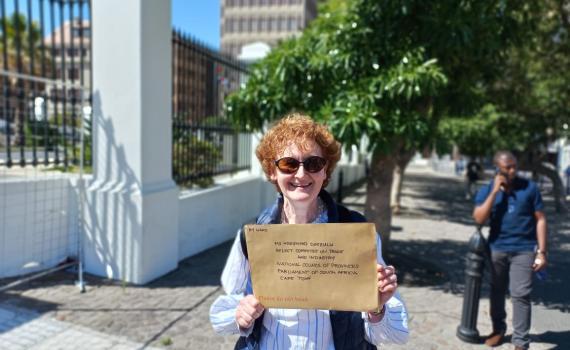
During the legislative process, EIFL has responded to multiple stakeholder consultations and sent written submissions in support of the Bill to the Department of Trade and Industry (DTI), the National Assembly and National Council of Provinces (NCOP) – South Africa’s two Houses of Parliament – and to South Africa’s President, Cyril Ramaphosa. We also testified at a public hearing held by the Office of the US Trade Representative amidst the threat of trade sanctions against South Africa after US-based copyright industries complained that the proposed law failed to adequately protect their interests.
Since the Copyright Amendment Bill was introduced in parliament in 2017, over 90 official activities and events have taken place, including public consultations, stakeholder meetings, technical expert reviews, legal briefings and debates, making it one of the most scrutinized copyright bills in the world. The Bill has twice been passed by both Houses of Parliament and sent to the President for assent. The President has twice questioned the constitutionality of some of the provisions (including copyright exceptions for educational and academic activities). As a result, the Bill [B13F-2017] is currently before South Africa’s highest court, and when the Constitutional Court publishes its decision, the fate of the Bill will be finally determined.
In the meantime, Blind SA took its own constitutional challenge against the 1978 Copyright Act that does not expressly permit the making of accessible format copies for people who are blind and visually impaired, arguing that it violated the Bill of Rights on issues of equality, dignity, education, culture and freedom of expression. In May 2025, the Constitutional Court issued its final judgement in the case to permit the making of accessible format copies, effectively bringing South African law into line with the Marrakesh Treaty. (Section 19D of the Copyright Amendment Bill - the exception for persons with disabilities - has been read into the 1978 Act by the Court until such time as the CAB is adopted or legislation to this effect is otherwise enacted).
From 2021 to 2023, our work in South Africa was generously supported by the project, ‘Contributing to Public Interest Copyright Policy at WIPO Promoting Access to Knowledge and the Right to Research'.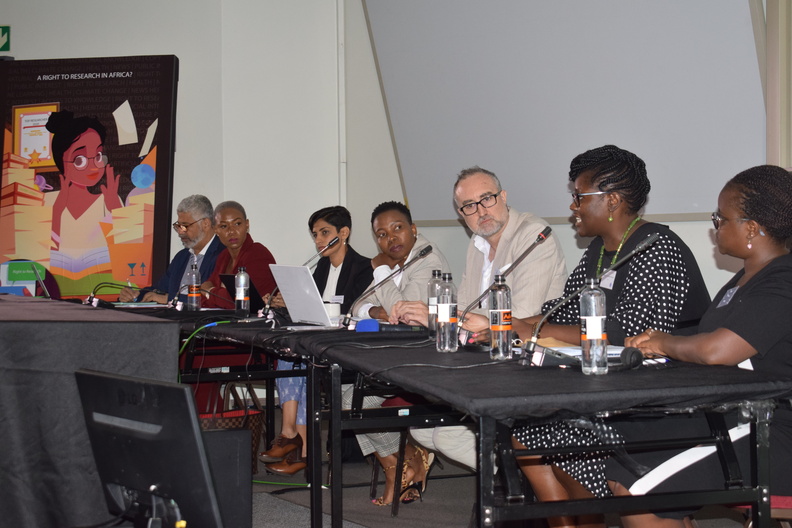
TIMELINE
2005 – ongoing
MAIN ACTIVITIES AND ACHIEVEMENTS
Built capacity of library leadership in copyright issues and advocacy
- EIFL’s Copyright Coordinator in South Africa attended three EIFL training events: Regional Copyright Training, Uganda (2005); EIFL Copyright and Libraries Global Conference, Istanbul (2008 & 2009).
- In 2023, EIFL co-organized an international conference in South Africa titled, ‘A Right to Research in Africa? A Week of Debates on Copyright and Access to Knowledge’. The conference took place in two cities (Pretoria and Cape Town) and was attended by over 280 librarians, researchers, legal academics, and senior copyright officials from South Africa, the African continent and beyond. Sessions included ‘Making the Copyright Amendment Bill work in South Africa’ and ‘After the Fires: Digitising our Heritage’ that highlighted obstacles created by copyright in preserving and digitizing Africa’s cultural heritage, especially in the context of the devastating fire at the University of Cape Town’s Jagger Library in 2021.
Supported copyright law reform
- In 2015, EIFL submitted comments to a public consultation organized by the Department of Trade and Industry (DTI) on the Copyright Amendment Bill (CAB). EIFL commended DTI on the framing of the Bill to increase access to knowledge, access to education and learning materials, and for persons with disabilities. We endorsed comments on the Bill by academic experts from South Africa and the US. The Joint Comments made extensive reference to EIFL’s Draft Law on Copyright (2014).
- By 2019, the Copyright Amendment Bill had progressed to the National Council of Provinces (NCOP), the second of South Africa’s two Houses of Parliament. In a public consultation, EIFL submitted comments to NCOP supporting three key sections of the Bill: exceptions to facilitate modern library activities and services, online learning, and use by people with disabilities. We also stressed the benefits of a flexible fair use-style exception that will keep the law relevant for longer. In March, the Bill was approved by both Houses and was duly sent to the President for signing into law.
- In November 2019, the Bill ran into trouble with threats of trade sanctions against South Africa. The Office of the US Trade Representative (USTR) accepted a complaint by US-based multinational copyright industries that the proposed law failed to adequately protect US copyrights (partially at fault, they said, were the expanded exceptions). As a result, USTR announced a review of South Africa’s participation in its largest preferential trade scheme for developing countries (known as the Generalized System of Preferences (GSP)), putting at risk South Africa’s participation in the African Growth and Opportunity Act (AGOA), and billions of dollars in South African exports to the US EIFL wrote to the President, Cyril Ramaphosa, urging him to sign the Bill into law - as a sovereign state, South Africa is fully entitled to make use of the flexibilities in the international copyright system (including exceptions and limitations) to devise a copyright law that meets the needs of its people, and the development priorities of the nation.
- In January 2020, EIFL testified at a public hearing for a GSP Country Practice Review on South Africa held at the Office of the US Trade Representative in Washington D.C. In its testimony in support of the government of South Africa, EIFL refuted claims that the CAB would violate South Africa’s international treaty obligations, or move South Africa away from international norms. To the contrary, the Bill aligns with international law, including the Marrakesh Treaty for persons with print disabilities, especially for digital content. We urged USTR to reject the complaint and to confirm that South Africa is meeting GSP criteria with respect to the protection of intellectual property rights. South Africa remains eligible for GSP.
- In June 2020, amidst the political pressure, the President decided not to sign the Bill. Instead, he returned it to the National Assembly for further consideration citing constitutional concerns with certain aspects, including the exceptions for educational and academic activities. In advance of a special briefing in August by the Portfolio Committee on Trade and Industry (the committee in charge of steering the bill through parliament) to review the President’s concerns, EIFL wrote to the Speaker of the National Assembly pledging our strong support, noting in particular, that fact that the exceptions are modelled on provisions in the copyright laws of several developed countries including Australia, Canada, Israel, Singapore, the UK and the US.
- In June 2021, the Portfolio Committee on Trade and Industry invited stakeholders to submit comments responding to the Presidents’ reservations on the Bill. EIFL reiterated its position that the exceptions in the Bill are consistent with South Africa’s treaty obligations, and it merely seeks to ensure that libraries and educational institutions in South Africa have the same rights as their counterparts in many developed countries.
- In January 2022, the Portfolio Committee on Trade and Industry launched a public consultation on a new version of the Bill prepared after input from the June 2021 public consultation. The amendments represented a step backwards. In its submission, EIFL criticized changes to the exception for libraries, archives, museums and galleries (Section 19C) - multiple new and overlapping conditions added to the exception made it very confusing and difficult to understand, even for trained legal professionals. Librarians, teachers, researchers and others expected to use the exception would find it almost impossible in practice. EIFL was pleased that the changes were consequently dropped from the Bill (in September), and the text brought back to its original form. The Bill was then passed by the National Assembly and forwarded to the NCOP (for the second time).
- In January 2023, EIFL participated in another call by the NCOP for comments on the Bill. EIFL’s comments highlighted how the Bill would have enabled online teaching and learning during the COVID-19 pandemic when libraries and educational institutions were forced to go online during lockdowns. (For more information, read EIFL’s guest blog How SA’s copyright bill would benefit citizens during COVID). In September, NCOP approved the Bill and transmitted it to the National Assembly to round up the legislative process.
- In December 2023, with signs that the schedule was starting to slip, EIFL wrote to the National Assembly expressing concern at apparent delays in its adoption of the Bill. We urged the Portfolio Committee on Trade, Industry and Competition to do all in its power to ensure that the Bill is cleared as soon as possible - the 1978 Copyright Act, adopted in the pre-internet era, is no longer fit for purpose. In February 2024, the Bill was approved and sent (for the second time) to the President for assent.
- In March 2024, EIFL wrote to the President, Cyril Ramaphosa, asking him to sign the Bill as the clock was ticking for completion of the legislative process before general elections were due to be held in May 2024. In the end, the President did not sign the Bill. For only the second time in South Africa’s history, the President referred a Bill, the Copyright Amendment Bill [B13F-2017], to the Constitutional Court for a ruling on certain aspects of its constitutionality.


