
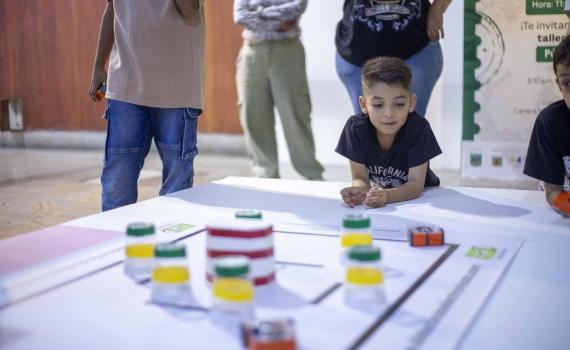
The Biblioteca de Empresas Públicas de Medellín (Biblioteca EPM) in Colombia goes beyond traditional library services by fostering spaces for art, culture, and above all, STEAM education (Science, Technology, Engineering, the Arts and Mathematics) with its standout robotics club made up of young people passionate about these topics. From this group, five members have been admitted to university engineering programmes.
"Thanks to the experience gained in training activities, tournament participation and other robotics events, they discovered their professional vocation, and these foundations have helped three of our students secure university scholarships," says the EPM Library Coordinator, Andrés Felipe Corrales Jaramillo.
The EPM Library promotes STEAM learning spaces in Medellín, neighbouring municipalities and surrounding rural areas through technological infrastructure and tools, practical skills workshops, outreach to urban and rural schools (including after-school training), and replicable, adaptable audiovisual educational content to foster autonomous STEAM learning.
The programme reaches students from primary school to university level, teachers, and rural community leaders through partnerships with local stakeholders, including universities, electronics distributors, other organizations and schools to make STEAM learning accessible to the community.
First experience of robotics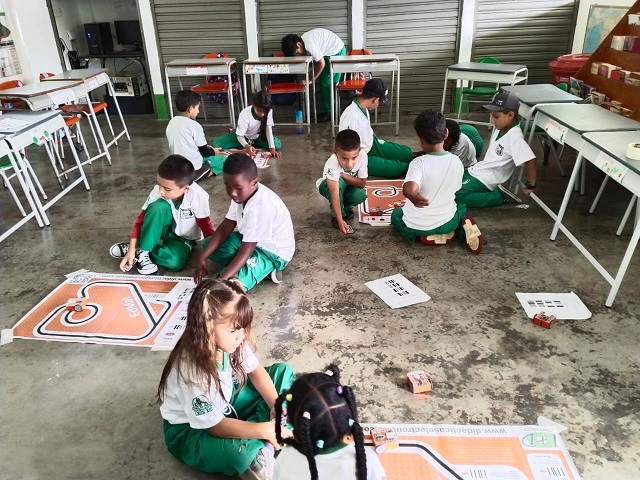
The educational approach integrates hands-on experimentation, problem-solving, and the development of critical thinking to encourage the application of scientific-technological knowledge in diverse contexts.
“Our training activities typically represent the first exposure to robotics, programming, 3D modelling and related topics for both students and teachers, whether through short workshops or deeper seedbeds, always with experimental projects. "We aim to offer projects using basic electronic components in rural schools so that students can keep them for further exploration," says Andrés.
"We have computers with free modeling and 3D printing software, six 3D printers of different sizes, speeds and qualities, one CNC machine (Computer Numerical Control – manufacturing tools for precise cutting, shaping, and drilling of materials like metal, plastic, and wood), electronics lab equipment including multimeters, power supplies, various hand tools, soldering station, sensors, actuators, and components for prototyping. The library also uses the Moodle platform to share online courses, learning resources, and audiovisual content designed by facilitators and continuously adjusted based on participant feedback," he adds.
Lending Robotics kits
"We've dreamed of a library that allows the community to borrow tools, electronic components, robotics kits, and more – just like borrowing a book. We're currently in an experimental stage, lending to our closest users and educational/university institutions, and demand grows each year," says Edgar José Montoya Álvarez, robotics team leader.
One of the highlight events is the annual Biblioteca EPM robot sumo tournament, where participants test their skills by building autonomous sumo robots that battle in a ring, pushing opponents without getting pushed out. Participation grows yearly, making it a popular city event. In its third year, in 2025, the tournament drew about 280 people, including students, parents and teachers.
Annually, the programme reaches around 10,000 people through activities and events. Evaluations show high satisfaction: over a third of participants apply what they have learnt in their daily activities. With EPM Library support, 15 educational institutions have strengthened their STEAM programmes and receive guidance and support for their own activities.
"We never imagined that from our town we could create technology to improve our families' quality of life," says one of 15 young people from the rural municipality of Buriticá, who participated in training and guidance to develop automated irrigation for community gardens, now in the testing phase.
STEAM for social inclusion
The programme contributes to social inclusion for people with diverse abilities. The robotics team developed AccessBot, which adapts electronic content for people with low vision or blindness and is freely available for the community to replicate and adapt. We also have a mediator who is a Colombian Sign Language interpreter, trained through collaborative activities with the Antioquia Association of the Deaf.
"An inspiring story is that of two 14-year-old autistic twin brothers. Their mother shared that thanks to the robotics seedbeds, they gained confidence and recognition from school peers," says one of the EPM Library mediators.
More public and community libraries supporting education.
PLIP-Education


