
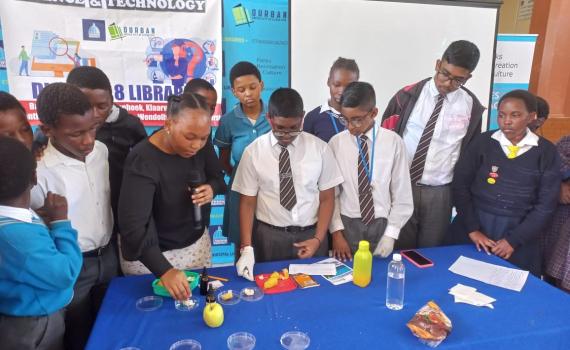
Over 90% of children living in under-resourced areas of eThekwini Municipality in South Africa have expressed interest in taking up careers in science and technology after participating in Woodhurst Public Library’s STEM Makers digital skills programme.
Over the past two years (2023 - 2025) Woodhurst library has worked with partners and nine branch libraries in District 8 of the eThekwini municipal area (near the city of Durban) to organize bi-monthly coding and robotics workshops and fun school holiday Stem Makers programmes. In 2025 the programme reached 450 learners.
“The eThekwini municipality spans urban, peri-urban and rural areas and libraries serve diverse middle class and low-income communities. These communities share socio-economic challenges experienced across the municipal area, such as high youth unemployment, limited access to quality education and low household incomes,” says Librarian Nomalungelo Hazel Ngcobo, head of Woodhurst Public Library.
Quality STEM (Science, Technology, Engineering and Mathematics) education is especially rare. Libraries that offer free access to computers and Wi-Fi serve as vital access points for digital tools and educational support.
STEM clubs and makerspaces to fill the gap
“Recognizing the gap in STEM exposure we introduced robotics activities and unplugged coding (in which children learn about computer programming through practical games, without using computers) and robotics activities. We followed up with the formation of STEM clubs and makerspaces in branch libraries. These initiatives are designed to make science, technology engineering and mathematics (STEM) relatable and hands-on,” says Nomalungelo.
The library’s main partners are the University of KwaZulu Natal (UKZN), whose students volunteer to facilitate workshops, the Eskom Expo for Young Scientists, South Africa's national annual science fair, and the non-profit organization Tangible Africa that develops systems for teaching children coding through play.
“With these partners we are able to create inclusive, engaging environments that foster curiosity, creativity, and lifelong learning - ultimately demystifying science and mathematics and empowering youth to pursue STEM careers and contribute meaningfully to their communities,” says Nomalungelo.
How the STEM Makers learn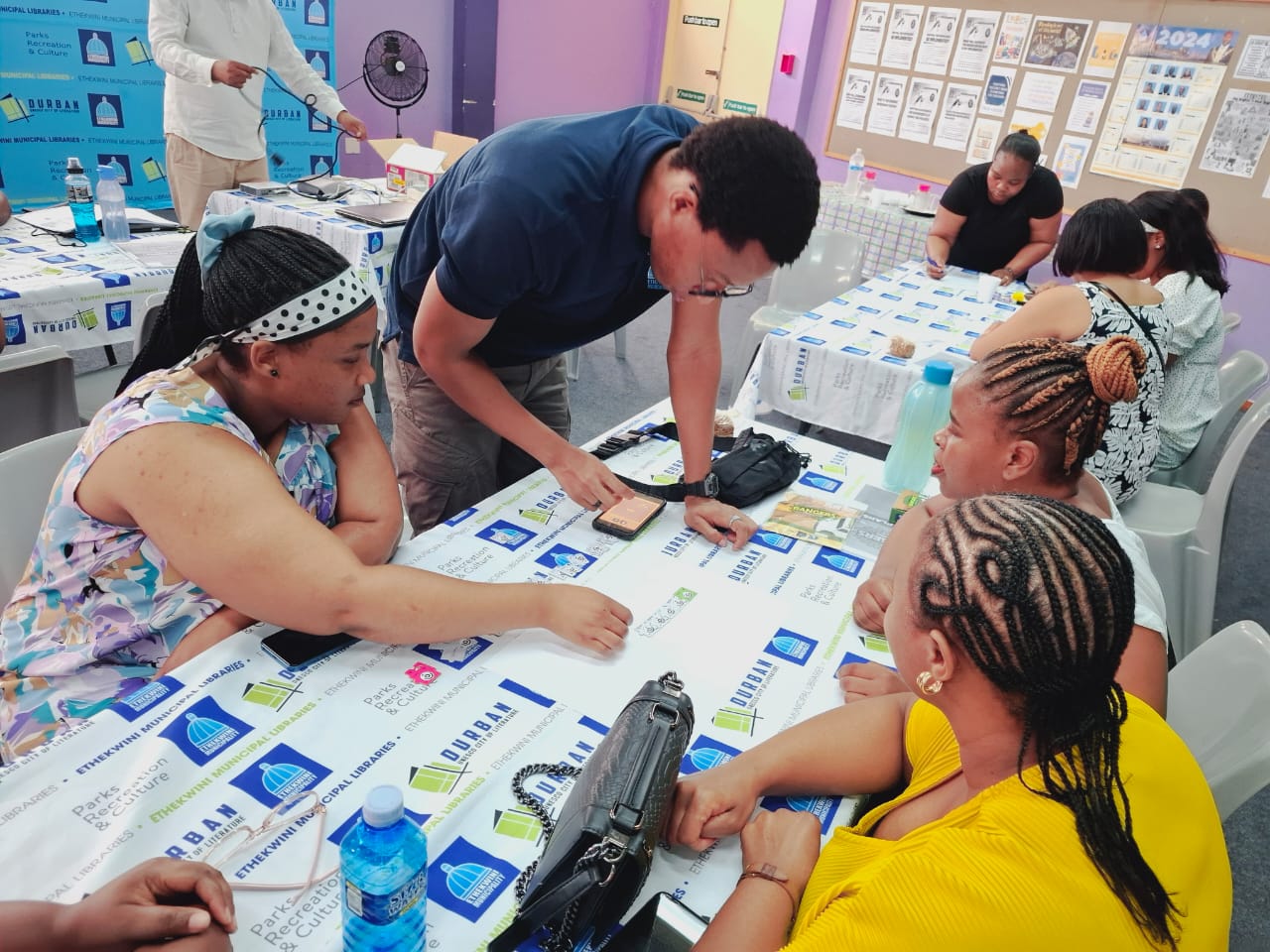
The libraries provide tablet and laptop computers, micro:bit kits, free Wi-Fi and access to online educational platforms. A key feature of the STEM Makers programme is the use of recyclable and low-cost materials - such as cardboard, plastic bottles and scrap electronics - for prototyping, making STEM accessible and environmentally conscious. The main activities are:
- Unplugged coding and robotics sessions to introduce computational thinking without reliance on advanced devices.
- Scientific experiments and project-based learning to apply theoretical knowledge.
- Maths games, model-making and innovation challenges to foster problem-solving and creativity.
- Participation in science fairs and exhibitions.
- Guest talks, workshops, and seminars in partnership with UKZN and other STEM stakeholders.
- Field trips to science museums and research centres.
- Reading and research workshops to strengthen literacy and scientific inquiry.
Improved awareness, digital literacy and confidence
The STEM Makers programme has improved STEM awareness, digital literacy and confidence among young people. Holiday activities in the libraries are especially popular: in April 2025 Woodhurst Public Library’s holiday programme, which ran over three days, attracted 90 children who conducted STEM experiments and learnt about coding; over 70 children at Klaarwater Public Library built structures in a STEM programme that aimed to inspire innovation in science and engineering.
“Coding taught me there are many ways to solve a problem. Now I feel confident using computers.” said a rural coding club participant.
Teachers have observed improved academic performance among coding club participants.
“The programme is ongoing, and participants are again busy with prototypes to enter into the Eskom Expo for Young Scientists competition. It is generating valuable information for scaling up to other libraries - and there are plans to introduce STEM programmes in all of eThekwini Municipality’s 92 public libraries soon,” says Nomalungelo.
More public and community libraries supporting education.
PLIP-Education


