
BACKGROUND
EIFL has been engaged in copyright work in Kenya since 2008.
We have provided training and built capacity among librarians in copyright and advocacy with our partner, the Kenya Libraries and Information Services Consortium (KLISC).
We have responded to public consultations on copyright law revisions that concern libraries, research and education. We have also made recommendations for library-friendly amendments, leading to improvements in the law.
We have supported take-up of the Marrakesh Treaty for persons with print disabilities (Kenya ratified and domesticated the treaty in 2017 and 2019 respectively), and in 2023, we co-launched the Kenyan edition of the 'Getting Started’ implementation guide with KLISC, the Kenya Copyright Board (KECOBO) and Bookshare Africa. Later in 2023, we expressed concern at proposed changes to the exception for blind and visually impaired persons in a new draft law that would significantly interfere with the objectives of the Marrakesh Treaty to increase the availibility of accessible format copies.
TIMELINE
2008 - ongoing
Main activities and achievements
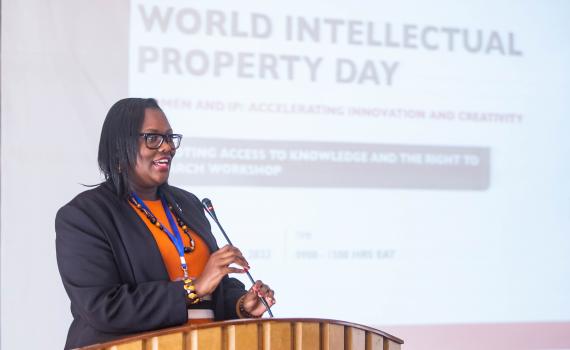
- Co-organized a workshop, 'Promoting Access to Knowledge and the Right to Research', 26 April 2023 in Nairobi with the Centre for Intellectual Property and Information Technology Law (CIPIT), Program on Information Justice and Intellectual Property (PIJIP) and KLISC, in cooperation with the Kenya Copyright Board (KECOBO). The event brought together national and international copyright experts from academia, the legal, policy and regulatory fields, and key stakeholders from the research, education, library and disability communities. During the workshop, co-launched the Kenyan edition of ‘Getting Started. Implementing the Marrakesh Treaty for persons with print disabilities’. Read and watch highlights of the workshop here.
- Supported research by CIPIT on the ‘Right to Research in Copyright Law - Text and Data Mining': CIPIT published a White Paper, a blog, and a podcast in The Friendly Troll. The research was part of the project, ‘Contributing to Public Interest Copyright Policy at WIPO Promoting Access to Knowledge and the Right to Research'.
- Co-hosted webinars with KLISC and the Kenya Copyright Board
- Artificial Intelligence / Big Data / Text and Data Mining, 3 March 2022. The webinar introduced copyright issues relating to Artificial Intelligence (AI), Big Data and Text and Data Mining (TDM, the potential of AI and the context for its use in Kenya, as well as the international perspective on copyright issues and AI. It helped to identify legal gaps at national and international levels, and steps needed to support the development of TDM/AI and Big Data as digital research tools.
- Fair Dealing and other Copyright Exceptions, 10 February 2022. The webinar raised awareness of fair dealing and other exceptions in the Kenya Copyright Act, and identified challenges among user communities in using these provisions. It took a look at reforms in the region (Nigeria), and the evolution of fair dealing internationally.
- The Marrakesh Treaty in Kenya, 3 December 2021. The webinar introduced the Marrakesh Treaty and why it is important for libraries, described the relevant provisions in Kenya’s copyright law, explained who is authorized to use the provisions, and identified areas that might need to be clarified in the law. It also covered the practical experience of libraries in Zimbabwe that are getting ready to use the treaty, and positive experiences of libraries around the world that are benefiting from cross-border exchange enabled by the treaty. Click here for the programme with links to the speaker slides.
- Built capacity of library leadership in copyright issues and advocacy:
- From 2008 to 2019 EIFL Copyright Coordinators in Kenya attended six EIFL training events: the Global EIFL-IP conference, Istanbul (2008 and 2009); Copyright Management Seminar, Kampala (2009); Library copyright statutes around the world, online (2016); Regional Seminar ‘Ending the book famine in Africa: libraries and the promise of the Marrakesh Treaty’, Lesotho (2017); Civil Society Workshop on Copyright and Advocacy, Nairobi (2019).
- KLISC librarians participated in international policy-making: WIPO Regional Seminar for the African Group on Libraries, Archives, Museums and Educational & Research Institutions in the Field of Copyright, Nairobi (2019); WIPO International Conference on Copyright Limitations and Exceptions for Libraries, Archives, Museums and Educational & Research Institutions, Geneva (2019).
- In 2019, the first librarians from Kenya took part in negotiations on library exceptions and limitations at WIPO’s Standing Committee on Copyright and Related Rights (SCCR/39) in Geneva. Read a profile of Prof Joseph Kavulya, University Librarian, who attended.
- Drafted proposals on the liability of Internet service providers (ISPs). The proposals improved and the meaning of certain provisions were clarified: ISP liability is of great interest to libraries that provide digital services, such as Internet access to their users, as well as indexes and location tools to third party websites.
- 2015: Responded to an invitation by the Kenya Copyright Board to stakeholders to comment on draft proposals to provide web blocking measures in cases of online copyright infringement. Comments by EIFL and KLISC on ISP liability proposals highlighted serious problems with two provisions: the short notice to disable access to allegedly infringing material (36 hours), and the imposition of harsh criminal and civil penalties when the ISP does not disable access upon receiving a takedown notice.
- 2015: Responded to an invitation by the Kenya Copyright Board to stakeholders to comment on draft proposals to provide web blocking measures in cases of online copyright infringement. Comments by EIFL and KLISC on ISP liability proposals highlighted serious problems with two provisions: the short notice to disable access to allegedly infringing material (36 hours), and the imposition of harsh criminal and civil penalties when the ISP does not disable access upon receiving a takedown notice.
- Provided recommendations for library-friendly amendments to copyright law: EIFL provided comments and has responded to public consultations on proposals for copyright law amendments that concern disability (implementing the Marrakesh Treaty), libraries, and educational institutions.
- 2026: EIFL submitted joint comments on Kenya’s Copyright and Related Rights Bill, 2026. From the perspective of research, education, and cultural heritage institutions, provisions on fair dealing and text and data analysis are more straightforward than the previous bill and easier for libraries and researchers to understand and apply. However, other amendments would have a negative impact. Read more here.
- 2023: EIFL expressed concern at radical changes proposed in the Copyright and Related Rights Bill, 2023 (First Draft) to the exception for blind and visually impaired persons. The 2023 Bill completely replaces the 2019 provision with new language. Instead of relying on the framework provided by the Marrakesh Treaty which is centered on authorized entities (AEs), such as libraries, making accessible copies for the benefit of people with disabilities, the new provision cuts out the role of AEs completely and instead limits its application to individual disabled persons, significantly diminishing the availability of accessible format copies. EIFL called for the restoration of the 2019 provision, and the deletion of this unnecessary change.
- 2021: EIFL and KLISC made six recommendations on Kenya’s draft policy framework for collective management organizations.
- 2020: Comments by EIFL and KLISC on the draft Intellectual Property Bill, 2020 which aims to consolidate existing laws relating to intellectual property. EIFL highlighted how the definitions found in the Copyright Act No. 12 of 2001, and the Schedule containing the exceptions and limitations are missing from the draft IP Bill, and it is essential that they are included.
- 2017: EIFL comments on the Copyright (Amendment) Bill, 2017 concerning disability, libraries and educational institutions, and liability of Internet Service Providers (ISPs) aimed at ironing out ambiguities, further improving ISP provisions, and ensuring that the benefits of the Marrakesh Treaty are maximized.
- 2017: EIFL prepared recommendations for Marrakesh-compliant amendments Copyright Act, 2001 (Revised Edition 2014).
- 2013: Recommendations for library-friendly amendments to the Copyright Act, 2001. EIFL analyzed activities core to the provision of effective library services, such as collection development, library lending, and support for education. The analysis found that, in many cases, the provisions were very limited, did not address contemporary technologies and that they fell short of library copyright exceptions in other countries.
- Engaged in advocacy for a fair outcome for the US-Kenya Free Trade Agreement: In Free Trade Agreements that contain a chapter on Intellectual Property, libraries are concerned with copyright issues. Typically four main issues are of concern: term of protection, limitations and exceptions, technological protection measures (TPMs), and enforcement measures.
- 2020: EIFL and KLISC prepared a Fact Sheet on the Proposed US-Kenya Free Trade Agreement, to raise awareness of the negotiations, and potential issues for libraries among the library community in Kenya.
- EIFL is coordinating a working group with Kenyan and US civil society to seek the best outcomes for libraries in Kenya.


