What is Koha?
Koha is an Integrated Library System with a range of features including:
- Online Public Access Catalogue (OPAC) module which provides a simple and clear interface for library users to perform tasks such as searching for and reserving items and suggesting new items.
- Full catalogue module which enables library staff to capture details of all library items. It is MARC compliant, and also z39.50 compliant, meaning data entry and exchange will be greatly simplified.
- Circulation module which fully automates borrowing and item management, integrating with the OPAC so users can see which items they have outstanding, for example.
- Acquisitions module which assists librarians with both acquisitions and more generally with budget management. Serials management and reporting modules perform functions that their names would suggest.
Koha is designed to work on Linux, but will work on Windows with the installation of a series of additional modules. It is operable in English. Spanish, Arabic and French, with other languages being developed and translated by the community members. It is released under a GNU General Public License (GPL)
Koha is is a well-established FOSS ILS and perhaps one of the most successful library FOSS tools currently, and as such the case for FOSS advocacy around Koha is stronger than it may be for software that is less well known.
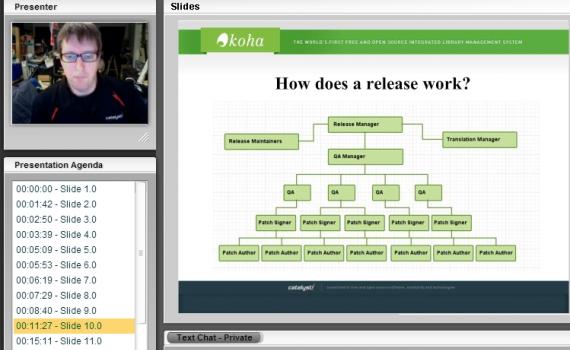
To begin to address some of these issues, we held an EIFL FOSS Themed Week focussing on Koha and library FOSS advocacy. It took place on June 14th 2011, but unfortunately there was a technical failure which resulted in the session reocrding not being made successfully.
The workshop featured contributors who described their experience with Koha and advocacy for FOSS tools, through their experience with Koha, including:
- Dave Parkes, Associate Director Information Services, Staffordshire University, UK (the first UK University to move fully to Koha).
- Dibyendra Hyoju, Madan Puraskar Pustakalaya, Nepal (currently working on a pilot to establish a Koha Union Catalog between 3 libraries).
- Gantulga Lkhagva, Mongolian Academy of Sciences
What are the benefits of Koha?
- Easy access to information for library staff and users due to effective searching and issuing of items.
- Automation of alerts to remind patrons and staff about, for example, overdue items or arrival of new items.
- Reduced time of processing of library items, due to MARC and z39.50 compatibility.
- Online supervision becomes possible, reducing the line management responsibilities of senior staff.
- Library management becomes easier through automated collection of data.
- Through the acquisition module budgets can be more effectively managed.
- Koha brings together library users and staff, as both can see various aspects of the system and can work together more effectively to achieve each user's goals.
Useful information about Koha
Case Studies
- Koha Case Study from Mzuzu University, Malawi
Read more about the Malawi, Mali and other EIFL FOSS Koha ILS Case Studies.
View (in ARABIC) a presentation by Abdelrazag Alhaj, the Sudan EIFL FOSS Coordinator, about the Koha experiences of Neelain University, Sudan.
Koha in action in EIFL partner countries
- Azerbaijan: Caucasus Research Resource Centre
- Malawi: Mzuzu University Library
- Mali: Library of the Faculty of Medicine, Pharmacy and Dentistry at the University of Bamako
- Nepal: Madan Puraskar Pustakalaya